
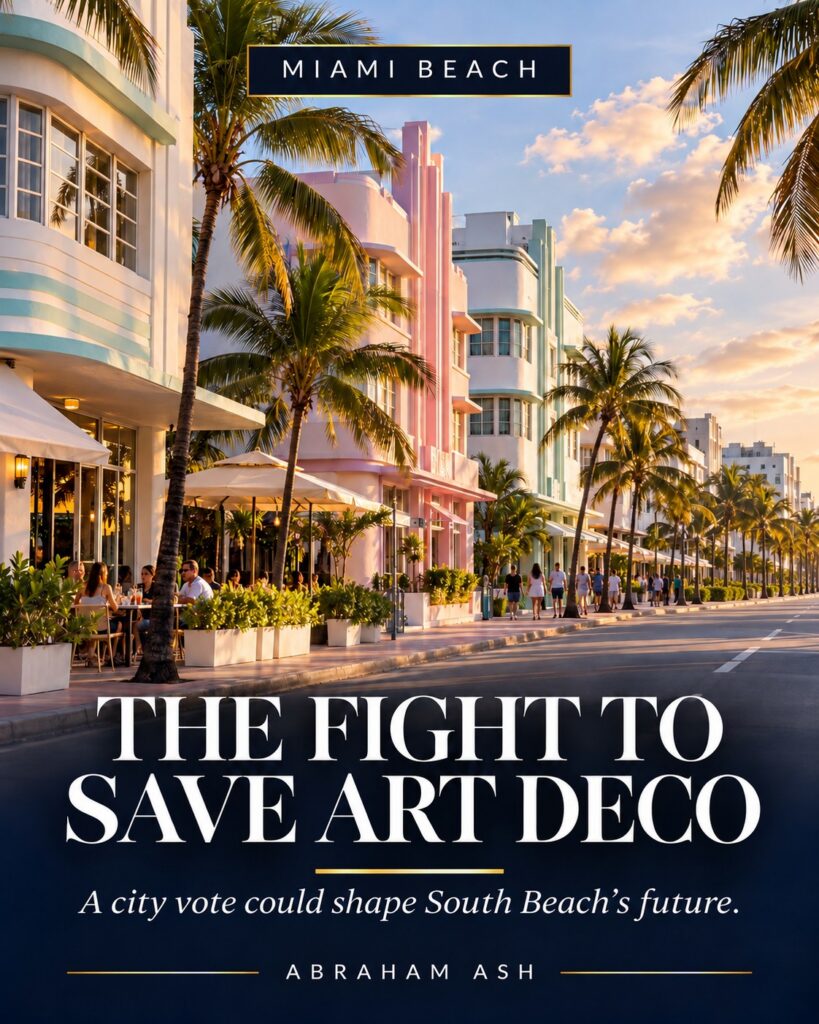
Miami Beach is weighing a lawsuit against the State of Florida over a 2024 law that makes it easier to tear down older coastal buildings, including some Art Deco hotels in South of Fifth. City commissioners are expected to vote on the question at their Wednesday, Nov. 18 meeting. For anyone who owns, or is shopping for, a condo in South Beach, the outcome could shape what gets built on the blocks around them for years.
What happened
The law at the center of the fight is the Resiliency and Safe Structures Act, signed in 2024. In plain terms, it lets owners demolish aging coastal buildings that don’t meet current FEMA flood standards, and it limits a coastal city’s power to block those demolitions or to require that parts of a historic building be saved. Properties inside historic districts listed on the National Register before January 1, 2000 are exempt, but many buildings that are protected only by a local historic designation are not, according to The Real Deal.
The project that brought this to a head is on Ocean Drive. Allied Partners wants to redevelop the 1937 Savoy and the 1941 Arlington hotels at 425 and 445 Ocean Drive into a 38-story, Arquitectonica-designed tower with hotel rooms, 90 condos and 60 workforce rental units. Under the plan, part of the Savoy would be kept and the Arlington would be fully demolished, WLRN reported. The developer is also using Florida’s Live Local Act, which allows extra height when 40% of units are set aside as workforce housing and lets projects skip some public hearings.
Both hotels sit in the city’s Ocean Beach Local Historic District, but just outside the National Register-listed Miami Beach Architectural District, which is why the state law reaches them. Commissioner (now Vice Mayor) Alex Fernandez told WLRN in September, “Our hands have been tied.” He is now sponsoring a resolution directing the city to sue, arguing that the act conflicts with the city’s home-rule powers and its federal historic-preservation duties. A companion item would ask Tallahassee to repeal the law.
This follows October votes in which commissioners told the city attorney to explore challenges to Live Local as well. Developer Russell Galbut has since withdrawn three Live Local projects totaling close to 400 units, The Real Deal reported.
What it means for buyers
- Look at the block, not just the building. In South of Fifth and other parts of South Beach, a low-rise neighbor that looks permanent may not be. Ask what lots nearby are under contract, in permitting or tied to Live Local or resiliency-act filings.
- Views and light are not guaranteed. A 38-story tower on Ocean Drive would be a big change in a part of the island known for low-scale buildings. If a view is part of what you’re paying for, factor in what could rise beside it.
- New supply could follow. If the law stands, more older hotels and apartment buildings could become condo sites, which means more new-construction choices over time in a submarket where new inventory has been scarce.
- Expect lawsuit noise. A city-versus-state case could take a long time, and projects caught in the middle may move slowly. Build that into any pre-construction timeline you’re counting on.
What it means for owners and sellers
Owners near a likely redevelopment site should know both sides of the coin. A tall new tower can bring construction disruption and change the feel of a street. It can also bring new retail, upgraded streetscapes and higher-priced comparables to the neighborhood. If you own an older building on a large lot, especially one that doesn’t meet current flood standards, its land value may matter more to developers now than it did a few years ago. That doesn’t mean you should sell, but it’s worth knowing what your site could be worth to someone with redevelopment plans.
Sellers in buildings that sit inside the National Register district can point out that their surroundings have stronger, long-standing protection, which some buyers will value.
Our take
South Beach’s Art Deco scale is a big part of why people want to be there, and the state’s resiliency push is also real: plenty of buildings near the ocean are low, old and exposed to flooding. The Nov. 18 vote won’t settle the question, but it will show how hard Miami Beach plans to fight. Whatever happens, the practical move for buyers is the same: do block-level homework before you sign, and read every building’s flood and reserve picture closely. For owners, it’s a good time to understand the redevelopment math around you.
If you’re watching a specific building, sign up for Building Alerts on any building page at Miami Beach condos, or call or text Abraham Ash at (305) 586-9734, Coldwell Banker Global Luxury.
Sources
- Will Miami Beach sue Florida over law enabling Art Deco teardowns? (The Real Deal)
- Savoy Hotel on Miami Beach and the Live Local Act (WLRN)
Considering a Move in Miami?
For discreet, strategic guidance on buying or selling luxury homes and condominiums in Miami, speak with Abraham directly.
Contact Abraham Ash