
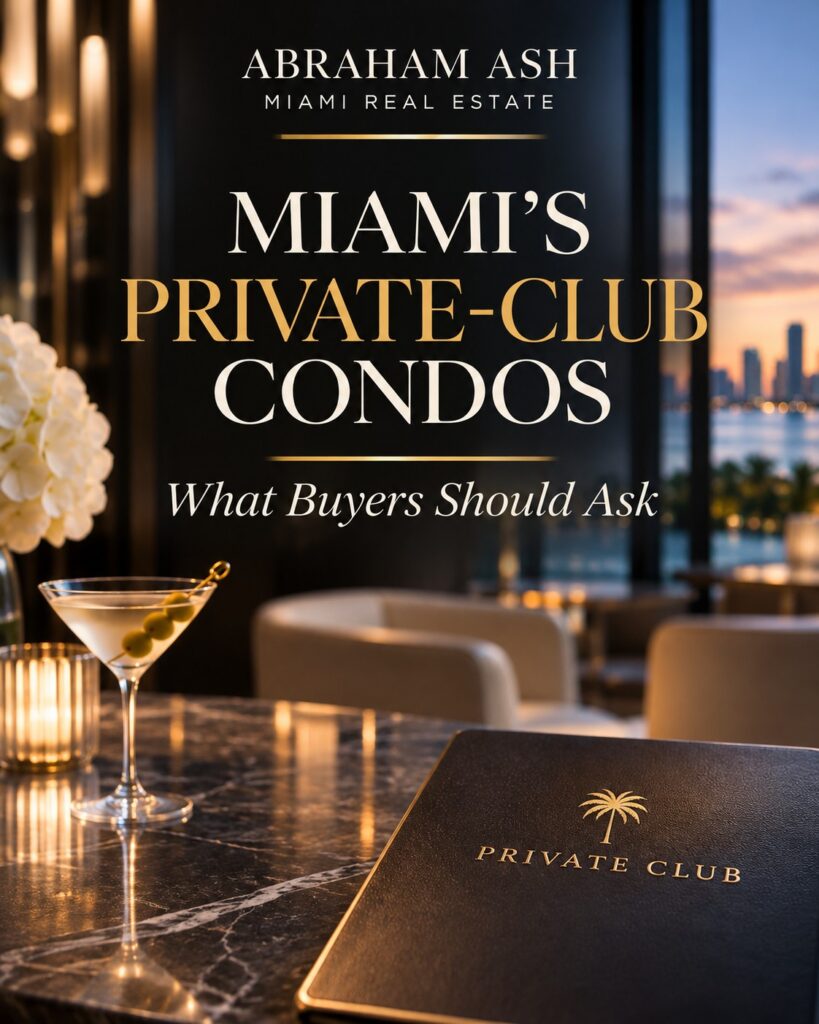
Miami’s luxury condo pitch is changing. For years, developers competed on views, ceiling heights and the name on the door. Now a growing number are leading with something harder to put on a floor plan: a private club, a members’ calendar, a reason to be in the building on a Tuesday night. If you are shopping new construction in Miami-Dade, it helps to understand what that club actually is, and what it is not.
What happened
Last week, The Real Deal reported on a panel at its Miami Real Estate Forum devoted to the growing role of private clubs in local real estate. Three executives shared how hospitality and membership are shaping their projects.
- Continuum Company runs Palm Tree Club Miami, a hotel and dockside restaurant in North Bay Village, next to its waterfront mixed-use complex. That complex is planned with 536 condos, offices, restaurants and a 20-slip marina, and its first phase was described as about half built. Continuum’s president said the club gives prospective buyers a way to experience the neighborhood and the water before they commit.
- Faena Rose, the arts and culture club in Miami Beach’s Faena District, hosts more than 80 events a year, from music to talks and master classes, and its president described membership as nearly full. He credited the post-pandemic wave of wealth moving to Miami with changing the trajectory of the business.
- Oak Capital, co-developer of Domus Brickell Park in Brickell, said a recognizable brand or a members-only restaurant is not enough on its own; what matters is whether people want to come back. Its CEO put it this way: “The right brand should help you determine how you feel in that building.”
The common thread: developers are selling community and service alongside square footage, and using clubs and hospitality partners to show buyers what daily life in a project will feel like.
What it means for buyers
A club can add real value: dining, programming, a marina, a concierge team that knows your name. It can also add cost and complexity. Before you sign a pre-construction contract, read the documents for answers to a few practical questions:
- Who owns and runs the club? Is it part of the condominium’s common elements, or a separate business owned by the developer or an operator? A club the association does not control can change its rules, pricing or operator over time.
- Is membership included, optional or mandatory? Some buildings bundle access into ownership; others charge separately. Ask whether there are initiation fees, annual dues or minimum spending requirements, and whether those can rise.
- Who else can join? If the club is open to non-residents, amenities may be busier, but outside members can also help support costs that would otherwise fall on owners.
- What happens if the brand or operator leaves? Look for language on license terms, renewals and what the association inherits.
None of these details showed up in the panel discussion, which is exactly why they belong on your checklist. The prospectus and declaration of condominium are where the real answers live.
What it means for owners and sellers
If you already own in a building with a strong club or hospitality program, that story is part of your listing. Buyers comparing a resale unit with a new launch often weigh amenities and service as heavily as finishes, so document what owners actually get: access, costs, and how the program is run.
If your building lacks a club, that is not necessarily a disadvantage. Many luxury buyers prefer lower carrying costs and fewer moving parts. Lead with what your building does well, such as location, privacy, waterfront access or reserves, and price with an eye on how nearby new construction is positioned.
Our take
Clubs are a smart marketing tool, and some of them will become genuine anchors for their neighborhoods. The Faena District is a good example of how culture and hospitality can shape a part of Miami Beach. But a club is only as durable as the agreement behind it. We would treat it like any other line in the budget: understand who controls it, what it costs today, what it could cost later, and whether you would still want the residence if the club changed tomorrow.
For buyers comparing options, it is worth looking at established Miami Beach condo buildings alongside the newest pre-construction projects. Resale buildings let you see real association budgets and how amenities are actually used, while new launches may offer more modern programming.
Want to stay on top of a specific building? Sign up for Building Alerts on any building page at abrahamash.com, or call or text Abraham Ash at (305) 586-9734, Coldwell Banker Global Luxury, to talk through the documents for a project you are considering.
Sources
Considering a Move in Miami?
For discreet, strategic guidance on buying or selling luxury homes and condominiums in Miami, speak with Abraham directly.
Contact Abraham Ash